How Schizophrenia Can Qualify for Disability Benefits

Atticus offers free, high-quality disability advice for Americans who can't work. Our team of Stanford and Harvard trained lawyers has a combined 15+ years of legal experience, and have helped over 10,000 Americans apply for disability benefits.
If you’ve struggled to hold a job because of your schizophrenia, you may qualify for disability benefits. In 2024, the Social Security Administration (SSA) awarded 404,350 workers on the schizophrenia spectrum with monthly benefits and free healthcare.
We’ll explain how the SSA defines schizophrenia, when it can qualify for disability benefits, and how to apply if you qualify.
Key takeaways:
Schizophrenia can qualify as a disability if it prevents you from working. The SSA considers schizophrenia a disability when symptoms like hallucinations, delusions, or disorganized thinking make it impossible to maintain a job.
You must meet strict SSA criteria with strong medical evidence. To qualify for SSDI or SSI benefits, you’ll need documented symptoms, ongoing treatment, and proof of severe limitations in areas like concentration, social interaction, or daily functioning.
Approval is challenging—but possible with the right support. Many applicants are initially denied, but thorough medical documentation and working with a disability lawyer can significantly improve your chances of receiving benefits.
Is schizophrenia a disability?
According to the SSA, schizophrenia is a disability if it makes it impossible for you to work. It’s important to know that the SSA has very strict criteria for mental disorders like schizophrenia, so it can be difficult to qualify even if your symptoms are severe.
How the SSA defines schizophrenia
People with schizophrenia typically struggle to interpret reality. While exact symptoms may vary, the SSA commonly looks for delusions, hallucinations, or disordered thinking, all of which can disrupt both personal and professional life. Schizophrenia usually requires long-term treatment, which is another of the criteria the SSA uses to evaluate your condition.
Common types of schizophrenia
There are several types of schizophrenia and related conditions, all of which have slightly different symptoms but can qualify for disability if severe enough:
Catatonic schizophrenia
Hebephrenic schizophrenia
Paranoid schizophrenia
Residual schizophrenia
Undifferentiated schizophrenia
Unspecified schizophrenia
Brief psychotic disorder
Delusional disorder
Schizoaffective disorder
Schizophreniform disorder
Schizotypal personality disorder
Learn more about conditions that qualify for disability benefits.
Can you get disability for schizophrenia?
Yes, you can get disability benefits for schizophrenia. However, qualifying for disability may be difficult because the SSA has strict criteria for evaluating mental health conditions. The SSA is more likely to approve you if you have another qualifying condition in addition to your schizophrenia.
Other conditions that you may experience alongside schizophrenia — and that can also qualify for disability benefits — include anxiety, depression, OCD, panic disorder, and PTSD.
To qualify, you’ll have to provide thorough medical documentation that your schizophrenia meets all SSA criteria. Since the application process isn’t always easy, we suggest working with an experienced disability lawyer. (Applicants who work with a lawyer are three times more likely to get approved for benefits.)
Criteria for getting disability with schizophrenia
Qualifying for disability with schizophrenia isn’t easy. But your odds of approval are higher if you have plenty of evidence that your schizophrenia is long-term and so severe that it keeps you from working.
Before you apply, consider whether or not your schizophrenia meets the following criteria. The SSA will want clear evidence that you meet the conditions for criteria A, plus one or both of criteria listed as B and C.
A. You have evidence of at least one of the following:
Delusions or hallucinations
Disorganized thinking or speech
Grossly disorganized behavior
Catatonia
AND
B. You have an extreme limitation in at least one of the following areas or a marked limitation in multiple:
Understand, remember, or apply new information
Interact with others
Concentrate or maintain a consistent pace of work
Adapt or manage your emotions and behaviors
OR
C. You have evidence that your schizophrenia is serious and persistent — it’s lasted for at least two years and continues to impact your ability to work — even though the following two statements are true:
You have received medical treatment, mental health therapy, psychosocial support, or care in a structured setting, and these treatments diminish your schizophrenia symptoms.
You struggle to adapt to changes in your life or to new demands that aren’t already part of your daily life.
Note that for criteria B, an extreme limitation is present if you are unable to function “independently, appropriately, effectively, and on a sustained basis.” Having a marked limitation means you may still be able to function independently but that your ability to do so is severely impacted or reduced.
7 questions to ask yourself before applying for disability
The SSA may approve you for disability benefits and healthcare if you can answer yes to the questions below:
Have you been seeing a psychiatrist for months in addition to any general providers?
Have you been hospitalized for your mental health recently?
Do you often experience hallucinations or delusions?
Is your thinking disordered?
Do you struggle to relate to others?
Is it difficult for you to adapt to change?
Do you struggle to take and incorporate feedback or criticism at work
My schizophrenia meets the criteria. Now what?
If your schizophrenia meets the criteria, we recommend that you apply for disability benefits as soon as you can. You can still apply if you’re unsure whether your condition qualifies, but the application is long and may only be worth it if you’re likely to be approved. Here’s what we suggest:
Apply now if:
You’ve been diagnosed with schizophrenia AND
You frequently experience delusions or hallucinations OR
You’ve had schizophrenia for at least two years, and you have evidence that you struggle to adapt to changes in your environment
Consider waiting and applying later if:
You have schizophrenia, but your doctor thinks your symptoms will improve within the next year, OR
Your schizophrenia hasn’t interfered with your work, even if you worry that it will soon
Probably don’t apply if:
Your schizophrenia isn’t stopping you from working, even though it’s occasionally disruptive OR
You’re working and earning more than about $1,600 per month
You can also take our free 2-minute disability quiz to see whether or not you’ll qualify before you start the application. If you qualify, we can match you with a vetted disability lawyer to increase your odds of approval. (You’ll only have to pay the lawyer if you get approved for benefits.)
Which type of benefits should you apply for?
The SSA offers two types of benefits: Social Security Disability Insurance (SSDI) and Supplemental Security Income (SSI). The benefits program you should apply for depends on your work and income history.
If you’ve worked for at least five of the last 10 years, SSDI offers higher monthly payments. If you have little to no income and assets, you may be eligible for SSI. The two programs do share an application, so you can apply for both to see which offers the best coverage for you. It’s also possible to receive benefits from SSDI and SSI at the same time.
We also have resources to help you if you’re applying for disability for your child or for a loved one.
How much is a disability check for schizophrenia?
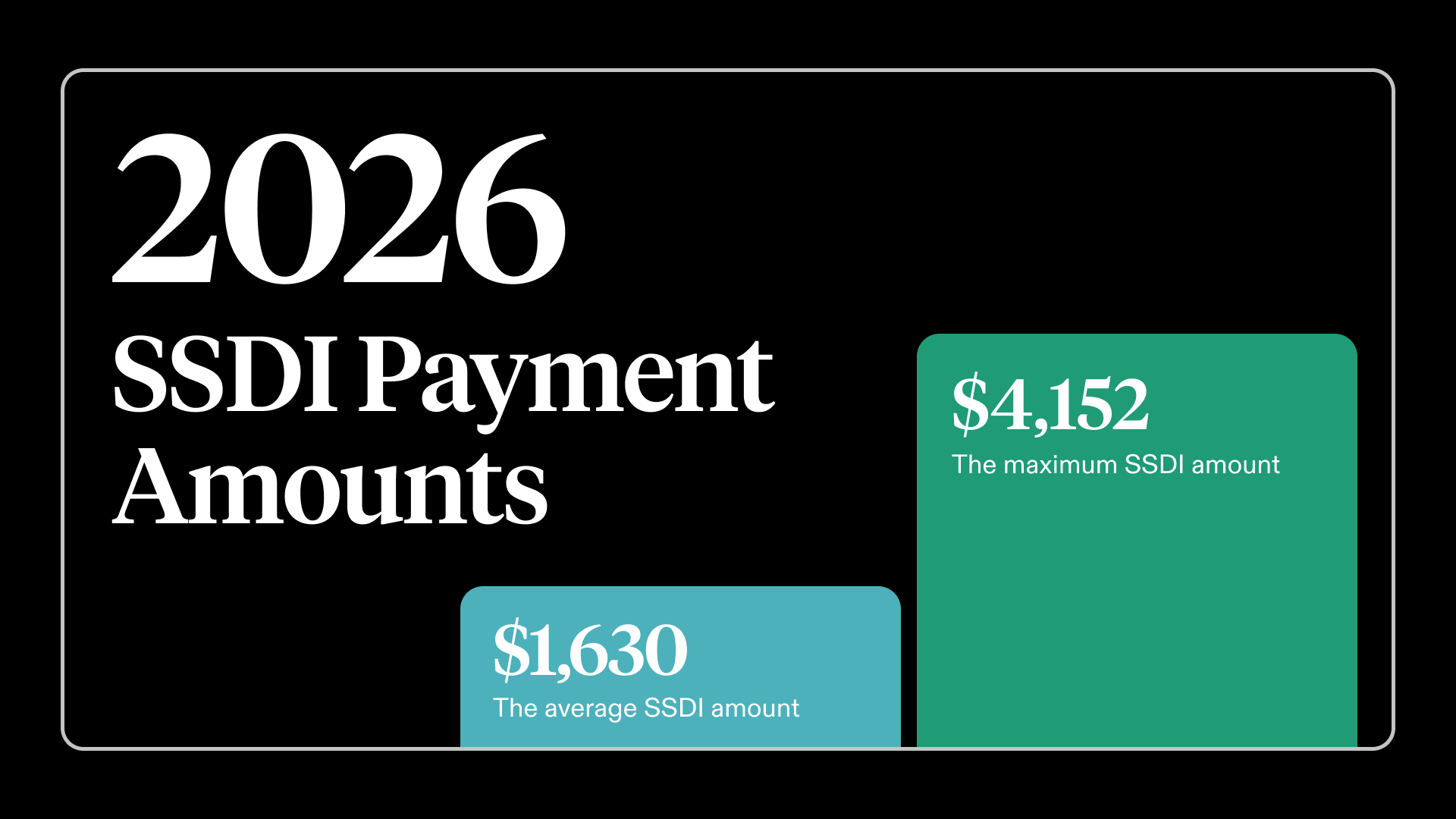
The average monthly disability check for schizophrenia and other psychotic disorders is $1,164.86. Your actual check size depends on your work and income history, as well as the type of benefits program you qualify for.
Regardless of your condition, the maximum monthly benefit is $4,152 for SSDI and $994 for SSI in 2026.
What if my schizophrenia doesn’t meet the criteria?
If your schizophrenia doesn’t meet all the criteria but still makes it impossible for you to work, applying may still be worth it. There’s no penalty for applying as long as you’re honest in your application. Just remember that the SSA will look for clear evidence that you cannot work because of your condition. Getting approved is also easier if you’re over 50.
Even if you feel that you’re likely to qualify, the reality is that qualifying for benefits is difficult. Only 20% of applicants get approved on their first try. You can still appeal and win benefits though! More than half of applicants who appeal their case in front of a judge end up getting approved for benefits. Your odds are also higher if you work with a disability lawyer.
For more support with your application, check out our step-by-step guide to applying for disability. You can also tap into these resources for people with disabilities if you need financial assistance during the application process.
Other conditions that can qualify for disability:
Inflammatory bowel disease (IBD) | OCD (obsessive-compulsive disorder) |
Related resources:
Qualifying for Disability: Everything You Should Know

Is it Hard to Get Disability for Mental Illness? (Yes, But This Can Help)

Is it hard to get disability for mental illness?
Can you get disability for mental illness?
While there are some additional challenges to getting disability with a mental illness, you can get SSDI or SSI for mental conditions. Around 34.6% of current disability applicants have a mental health condition of some kind. Read more about how to qualify here.
Is it hard to get disability for mental illness?
It can be harder to get disability benefits with a mental illness, but it’s still possible. The Social Security disability evaluation process is heavily based on medical evidence, so you’ll want to work closely with your doctors to document your limitations. Read more application tips here.
What mental illnesses qualify for disability?
Any mental illness that prevents you from working can qualify for disability benefits. Amongst the most common are anxiety, depression, bipolar disorder, developmental disorders, autism spectrum disorders, obsessive-compulsive disorders, and schizophrenia spectrum disorders. For a full list of conditions that qualify (including the conditions that medically qualify automatically) head here.
How do you apply for disability for mental illness?
You can apply online, in-person, over-the-phone, or with the help of an attorney. If you don’t have a lawyer, we recommend applying in-person at an SSA office. You’ll want to make sure you have all your employment and medical records ready. Read our full application guide to ensure your best chances of success.
Can I still work while applying for disability benefits?
Legally, disability benefits are for people who are too sick to work—and working too much may indicate to the Social Security Administration that you don’t actually need benefits. If you’re not working full-time, and are making below the SSA’s mandated maximum amounts per month, you can still apply. For the full details on working and SSDI/SSI, read more here.
Will the SSA or the judge reject my disability application because I use drugs or alcohol?
Technically, you can get approved for disability even if you’re currently abusing drugs or alcohol as long as you can show that your medical condition would still be disabling if you were sober. If your medical records show that your medical condition would go away if you did not drink or use drugs, your application will be denied. We answered this question more thoroughly in our “Ask Atticus” column.
Jackie Jakab
Lead Attorney
For Clients
Fields of Law
For Lawyers
At the bottom of many websites, you'll find a small disclaimer: "We are not a law firm and are not qualified to give legal advice." If you see this, run the other way. These people can't help you: they're prohibited by law from giving meaningful advice, recommending specific lawyers, or even telling you whether you need a lawyer at all.
There’s no disclaimer here: Atticus is a law firm, and we are qualified to give legal advice. We can answer your most pressing questions, make clear recommendations, and search far and wide to find the right lawyer for you.
Two important things to note: If we give you legal advice, it will be through a lawyer on our staff communicating with you directly. (Don't make important decisions about your case based solely on this or any other website.) And if we take you on as a client, it will be through a document you sign. (No attorney-client relationship arises from using this site or calling us.)
- © 2026 Atticus Law, P.C.
Terms | Privacy | California Privacy | CHD Policy | Disclaimer | This website is lawyer advertising.