SSA Grid Rules Explained: The Full Chart by Age, Education, and Work Capacity

Atticus is a law firm and Certified B Corp offering free, high-quality advice to Americans who can't work due to disability. Our experienced disability lawyers bring 50+ combined years of experience and help 100,000+ apply for benefits each year.

Legally reviewed by Paul Leroux, JD
Key takeaways
The SSA grid rules apply at step 5 of the 5-step disability determination process.
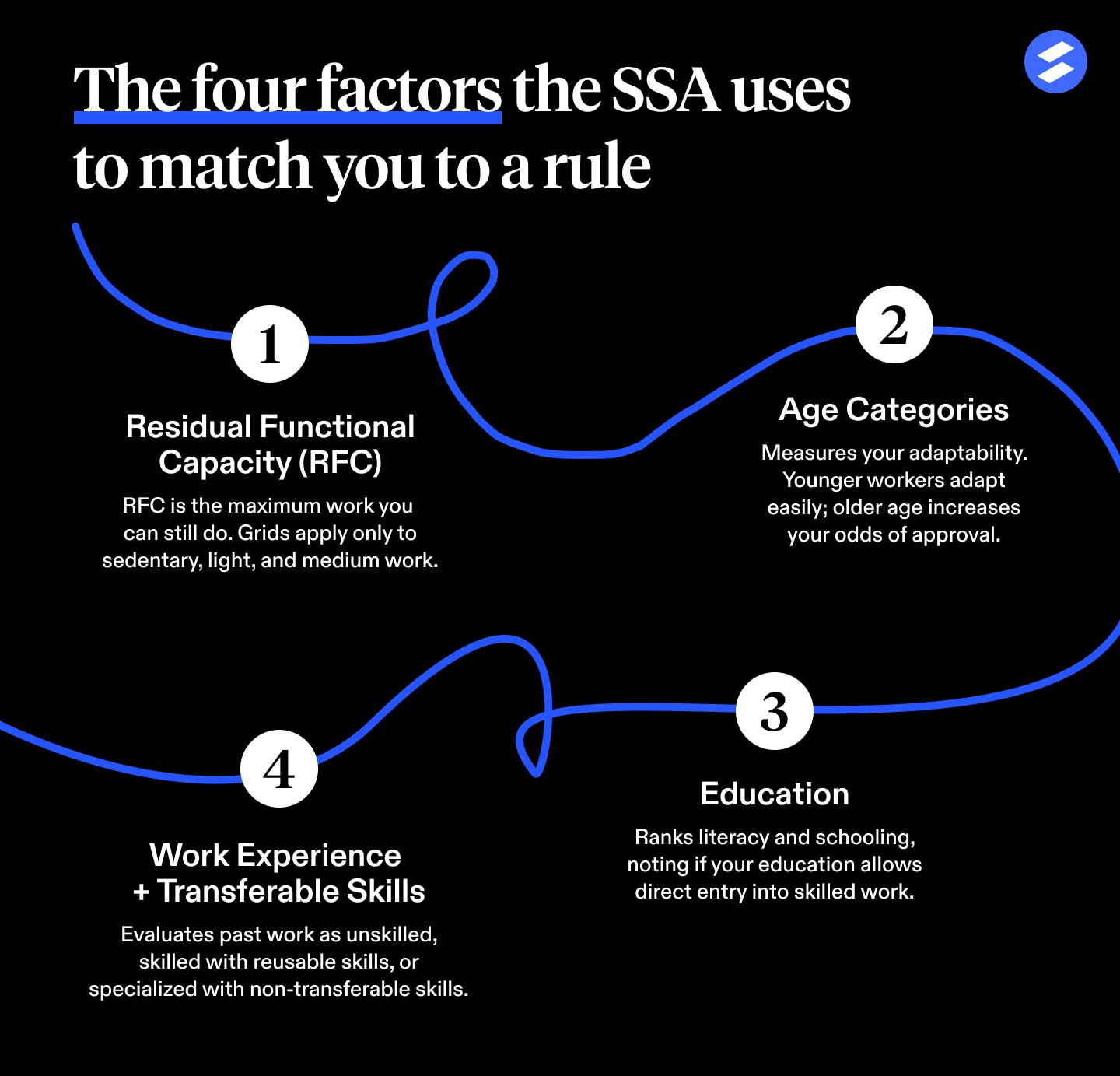
The SSA considers four factors to decide if you can adjust to new work despite medical limitations: residual functional capacity, age, education, and work experience.
Age is highly factored in, with a big change starting at age 50. If you are younger than age 50, the SSA does not consider your age to be a limiting factor in working. Over age 50 is when age becomes more of a consideration in adjusting to new work.
The grid rules don't include if you are still able to perform heavy or very heavy work. At that point, it is assumed that your disability is not a limiting enough factor for employment.
Qualifying for Social Security Disability can be a years-long process. It can no doubt become frustrating and, at times, confusing. You want a swift decision, and one that will recognize your disability and go your way.
As you’re moving through the disability approval process you might come to the point where SSA grid rules apply. These are a set of rules that are used to determine if you can adjust to other work, leading to the SSA’s decision if you are or not disabled.
Here’s a deep dive into the SSA grid rules, including what they mean, the four factors that decide which rule applies, how turning 50, 55, or 60 changes the odds, and how a disability attorney can help you determine where you fall on the grid, help your case, and guide you in the appeals stage.
What are SSA grid rules?
The Social Security Administration (SSA) grid rules, or Medical-Vocational Guidelines, are a set of rules that direct a disability decision based on four factors, including residual functional capacity (RFC), age, education, and work experience. The SSA grid rules apply at step 5 of the 5-step disability determination process. According to the SSA, the grids do not ever decide you have a disability.
When do grid rules apply — and when don't they?
The SSA uses a 5-step process to determine if you have a qualifying disability. The SSA’s 5-step sequential evaluation process looks like this:
Are you working? (The SSA uses earning guidelines to evaluate if your work is considered a substantial gainful activity.)
Is your condition “severe”?
Is your condition found in the list of disabling conditions? (Check to see if your condition appears as a Blue Book listing.)
Can you do the work you did previously?
Can you do any other type of work?
Note that step 3, unlike the other steps, is not a necessary step to get approved, but rather a way of bypassing steps 4 and 5. Many if not most people are approved without succeeding at step 3.
Step 5 is where the grid rules come in. “The final step, step 5, evaluates whether a claimant is capable of performing other work that exists in ‘significant numbers’ in the national economy,” says Atticus managing attorney Sydney Hershenhorn.
It’s this step that the SSA considers if you can adjust to other work despite your medical conditions. If the answer is no, you may be eligible for disability benefits. “These rules were effective in 1979 in an effort to achieve more consistency in decision-making across SSA,” explains Hershenhorn. “The grids are not a tool for denying people and they are not a tool for approving them. They were adopted as a consistency tool.”
The four factors the SSA uses to match you to a rule
Fortunately, the SSA does not keep the factors behind the grid rules a secret — in fact, they keep them laid out in a chart, which you can either scan on your own or lean on a disability lawyer for guidance on.
There are four factors that are used to match you to a rule. Here’s a quick look at each:
Residual functional capacity (RFC)
Residual functional capacity is defined as “the maximum degree to which the individual retains the capacity for sustained performance of the physical-mental requirements of jobs,” per the SSA. Basically: Can you do a job in this category?
Physical RFC is broken down into sedentary work, light work, medium work, or heavy or very heavy work categories. There are separate grid rules for sedentary, light, and medium work. The grids do not apply if your RFC is heavy or very heavy work.
Age categories
When you’re younger, you’re more likely to be able to adjust to new work, despite education or previous work. As you age, your ability to adapt to the physical or mental requirements of a new role decreases. With older age, it’s more likely — but never guaranteed — that the SSA may find you disabled.
Education
Depending on the work, there may be educational requirements. Categories for education include “illiterate,” “limited or marginal, but not illiterate,” “limited or less,” and “high school graduate or more” separated into two subcategories (a. does not provide for direct entry into skilled work and b. provides for direct entry into skilled work). Illiteracy may limit the type of work you can do, but jobs that don’t require special training are typically still an option.
Work experience & transferable skills
What you’ve done prior on the job matters to what you may be able to do today. For example, is your past work experience in an unskilled field (or none)? Did you work in a skilled or semi-skilled field where your skills are transferable, that is, they can be used in a different way? Or were you in such a specialized field that now your skills are not transferable?
The SSA grid rules chart
The Social Security grid rules chart is broken up into three categories: Sedentary / light / medium work. In each table, you’ll see three factors that are used to determine the SSA’s decision on if you are disabled or not disabled. These factors are age, education, and previous work experience.
You will notice that there is no table for heavy or very heavy work. We explain why after the grid tables below
The following tables come from Social Security’s Code of Federal Regulations. You can use them to help you understand where you might fall in the SSA’s decision. “Each row of a chart is a ‘rule’ that ends in ‘disabled’ or ‘not disabled,’” explains Hershenhorn. If your situation matches the criteria in the row exactly, the result is binding, she says.
Table 1 Sedentary work
Residual Functional Capacity: Maximum Sustained Work Capability Limited to Sedentary Work as a Result of Severe Medically Determinable Impairment(s)
Rule | Age | Education | Previous work experience | Decision |
201.01 | Advanced age (55-59) | Limited or less | Unskilled or none | Disabled |
201.02 | Advanced age (55-59) | Limited or less | Skilled or semiskilled—skills not transferable | Disabled |
201.03 | Advanced age (55-59) | Limited or less | Skilled or semiskilled—skills transferable | Not disabled |
201.04 | Advanced age (55-59) | High school graduate or more—does not provide for direct entry into skilled work | Unskilled or none | Disabled |
201.05 | Advanced age (55-59) | High school graduate or more—provides for direct entry into skilled work | Unskilled or none | Not disabled |
201.06 | Advanced age (55-59) | High school graduate or more—does not provide for direct entry into skilled work | Skilled or semiskilled—skills not transferable | Disabled |
201.07 | Advanced age (55-59) | High school graduate or more—does not provide for direct entry into skilled work | Skilled or semiskilled—skills transferable | Not disabled |
201.08 | Advanced age (55-59) | High school graduate or more—provides for direct entry into skilled work | Skilled or semiskilled—skills not transferable | Not disabled |
201.09 | Closely approaching advanced age (50-54) | Limited or less | Unskilled or none | Disabled |
201.10 | Closely approaching advanced age (50-54) | Limited or less | Skilled or semiskilled—skills not transferable | Disabled |
201.11 | Closely approaching advanced age (50-54) | Limited or less | Skilled or semiskilled—skills transferable | Not disabled |
201.12 | Closely approaching advanced age (50-54) | High school graduate or more—does not provide for direct entry into skilled work | Unskilled or none | Disabled |
201.13 | Closely approaching advanced age (50-54) | High school graduate or more—provides for direct entry into skilled work | Unskilled or none | Not disabled |
201.14 | Closely approaching advanced age (50-54) | High school graduate or more—does not provide for direct entry into skilled work | Skilled or semiskilled—skills not transferable | Disabled |
201.15 | Closely approaching advanced age (50-54) | High school graduate or more—does not provide for direct entry into skilled work | Skilled or semiskilled—skills transferable | Not disabled |
201.16 | Closely approaching advanced age (50-54) | High school graduate or more—provides for direct entry into skilled work | Skilled or semiskilled—skills not transferable | Not disabled |
201.17 | Younger individual age 45-49 | Illiterate | Unskilled or none | Disabled. |
201.18 | Younger individual age 45-49 | Limited or Marginal, but not Illiterate | Skilled or semiskilled—skills not transferable | Not disabled. |
201.19 | Younger individual age 45-49 | Limited or less | Skilled or semiskilled—skills not transferable | Not disabled. |
201.20 | Younger individual age 45-49 | Limited or less | Skilled or semiskilled—skills transferable | Not disabled. |
201.21 | Younger individual age 45-49 | High school graduate or more | Skilled or semiskilled—skills not transferable | Not disabled. |
201.22 | Younger individual age 45-49 | High school graduate or more | Skilled or semiskilled—skills transferable | Not disabled. |
201.23 | Younger individual age 18-44 | Illiterate | Unskilled or none | Not disabled. |
201.24 | Younger individual age 18-44 | Limited or Marginal, but not Illiterate | Unskilled or none | Not disabled. |
201.25 | Younger individual age 18-44 | Limited or less | Skilled or semiskilled—skills not transferable | Not disabled. |
201.26 | Younger individual age 18-44 | Limited or less | Skilled or semiskilled—skills transferable | Not disabled. |
201.27 | Younger individual age 18-44 | High school graduate or more | Unskilled or none | Not disabled. |
201.28 | Younger individual age 18-44 | High school graduate or more | Skilled or semiskilled—skills not transferable | Not disabled. |
201.29 | Younger individual age 18-44 | High school graduate or more | Skilled or semiskilled—skills transferable | Not disabled. |
Table 2 Light work
Residual Functional Capacity: Maximum Sustained Work Capability Limited to Light Work as a Result of Severe Medically Determinable Impairment(s)
Rule | Age | Education | Previous work experience | Decision |
202.01 | Advanced age | Limited or less | Unskilled or none | Disabled. |
202.02 | Advanced age | Limited or less | Skilled or semiskilled—skills not transferable | Disabled. |
202.03 | Advanced age | Limited or less | Skilled or semiskilled—skills transferable | Not disabled. |
202.04 | Advanced age | High school graduate or more—does not provide for direct entry into skilled work | Unskilled or none | Disabled. |
202.05 | Advanced age | High school graduate or more—provides for direct entry into skilled work | Unskilled or none | Not disabled. |
202.06 | Advanced age | High school graduate or more—does not provide for direct entry into skilled work | Skilled or semiskilled—skills not transferable | Disabled. |
202.07 | Advanced age | High school graduate or more—does not provide for direct entry into skilled work | Skilled or semiskilled—skills transferable | Not disabled. |
202.08 | Advanced age | High school graduate or more—provides for direct entry into skilled work | Skilled or semiskilled—skills not transferable | Not disabled. |
202.09 | Closely approaching advanced age | Illiterate | Unskilled or none | Disabled. |
202.10 | Closely approaching advanced age | Limited or Marginal, but not Illiterate | Unskilled or none | Not disabled. |
202.11 | Closely approaching advanced age | Limited or less | Skilled or semiskilled—skills not transferable | Not disabled. |
202.12 | Closely approaching advanced age | Limited or less | Skilled or semiskilled—skills transferable | Not disabled. |
202.13 | Closely approaching advanced age | High school graduate or more | Unskilled or none | Not disabled. |
202.14 | Closely approaching advanced age | High school graduate or more | Skilled or semiskilled—skills not transferable | Not disabled. |
202.15 | Closely approaching advanced age | High school graduate or more | Skilled or semiskilled—skills transferable | Not disabled. |
202.16 | Younger individual | Illiterate | Unskilled or none | Not disabled. |
202.17 | Younger individual | Limited or Marginal, but not Illiterate | Unskilled or none | Not disabled. |
202.18 | Younger individual | Limited or less | Skilled or semiskilled—skills not transferable | Not disabled. |
202.19 | Younger individual | Limited or less | Skilled or semiskilled—skills transferable | Not disabled. |
202.20 | Younger individual | High school graduate or more | Unskilled or none | Not disabled. |
202.21 | Younger individual | High school graduate or more | Skilled or semiskilled—skills not transferable | Not disabled. |
202.22 | Younger individual | High school graduate or more | Skilled or semiskilled—skills transferable | Not disabled. |
Table 3 Medium work
Residual Functional Capacity: Maximum Sustained Work Capability Limited to Medium Work as a Result of Severe Medically Determinable Impairment(s)
Rule | Age | Education | Previous work experience | Decision |
203.01 | Closely approaching retirement age | Marginal or Illiterate | Unskilled or none | Disabled. |
203.02 | Closely approaching retirement age | Limited or less | None | Disabled. |
203.03 | Closely approaching retirement age | Limited | Unskilled | Not disabled. |
203.04 | Closely approaching retirement age | Limited or less | Skilled or semiskilled—skills not transferable | Not disabled. |
203.05 | Closely approaching retirement age | Limited or less | Skilled or semiskilled—skills transferable | Not disabled. |
203.06 | Closely approaching retirement age | High school graduate or more | Unskilled or none | Not disabled. |
203.07 | Closely approaching retirement age | High school graduate or more—does not provide for direct entry into skilled work | Skilled or semiskilled—skills not transferable | Not disabled. |
203.08 | Closely approaching retirement age | High school graduate or more—does not provide for direct entry into skilled work | Skilled or semiskilled—skills transferable | Not disabled. |
203.09 | Closely approaching retirement age | High school graduate or more—provides for direct entry into skilled work | Skilled or semiskilled—skills not transferable | Not disabled. |
203.10 | Advanced age | Limited or less | None | Disabled. |
203.11 | Advanced age | Limited or less | Unskilled | Not disabled. |
203.12 | Advanced age | Limited or less | Skilled or semiskilled—skills not transferable | Not disabled. |
203.13 | Advanced age | Limited or less | Skilled or semiskilled—skills transferable | Not disabled. |
203.14 | Advanced age | High school graduate or more | Unskilled or none | Not disabled. |
203.15 | Advanced age | High school graduate or more—does not provide for direct entry into skilled work | Skilled or semiskilled—skills not transferable | Not disabled. |
203.16 | Advanced age | High school graduate or more—does not provide for direct entry into skilled work | Skilled or semiskilled—skills transferable | Not disabled. |
203.17 | Advanced age | High school graduate or more—provides for direct entry into skilled work | Skilled or semiskilled—skills not transferable | Not disabled. |
203.18 | Closely approaching advanced age | Limited or less | Unskilled or none | Not disabled. |
203.19 | Closely approaching advanced age | Limited or less | Skilled or semiskilled—skills not transferable | Not disabled. |
203.20 | Closely approaching advanced age | Limited or less | Skilled or semiskilled—skills transferable | Not disabled. |
203.21 | Closely approaching advanced age | High school graduate or more | Unskilled or none | Not disabled. |
203.22 | Closely approaching advanced age | High school graduate or more—does not provide for direct entry into skilled work | Skilled or semiskilled—skills not transferable | Not disabled. |
203.23 | Closely approaching advanced age | High school graduate or more—does not provide for direct entry into skilled work | Skilled or semiskilled—skills transferable | Not disabled. |
203.24 | Closely approaching advanced age | High school graduate or more—provides for direct entry into skilled work | Skilled or semiskilled—skills not transferable | Not disabled. |
203.25 | Younger individual | Limited or less | Unskilled or none | Not disabled. |
203.26 | Younger individual | Limited or less | Skilled or semiskilled—skills not transferable | Not disabled. |
203.27 | Younger individual | Limited or less | Skilled or semiskilled—skills transferable | Not disabled. |
203.28 | Younger individual | High school graduate or more | Unskilled or none | Not disabled. |
203.29 | Younger individual | High school graduate or more—does not provide for direct entry into skilled work | Skilled or semiskilled—skills not transferable | Not disabled. |
203.30 | Younger individual | High school graduate or more—does not provide for direct entry into skilled work | Skilled or semiskilled—skills transferable | Not disabled. |
203.31 | Younger individual | High school graduate or more—provides for direct entry into skilled work | Skilled or semiskilled—skills not transferable | Not disabled. |
Why there’s no grid table for heavy or very heavy work (Rule 204.00)
If you are physically able to do heavy or very heavy work, the grids do not direct a decision. According to the SSA, having the residual functional capacity to perform heavy work or very heavy work also means that you can do “work at the lesser functional levels.” In short, you have what they consider to be “substantial work capacity at all skill and physical demand levels. In those cases, the SSA typically decides your condition isn't severe enough to keep you from working.. That usually leads to a "not disabled" decision, regardless of your age, education or work history, unless you can show that you are unable to sustain the demands of full time work.
How age changes your odds
Social Security disability at or above age 50 is a different consideration from social security before age 50, as age changes your odds of being approved for disability. The grids particularly help people 50 and over with physical limitations, says Hershenhorn. “Age matters in a disability claim because SSA treats advancing age as an increasing limitation in a person’s ability to adjust to work they’ve never done,” says Hershenhorn.
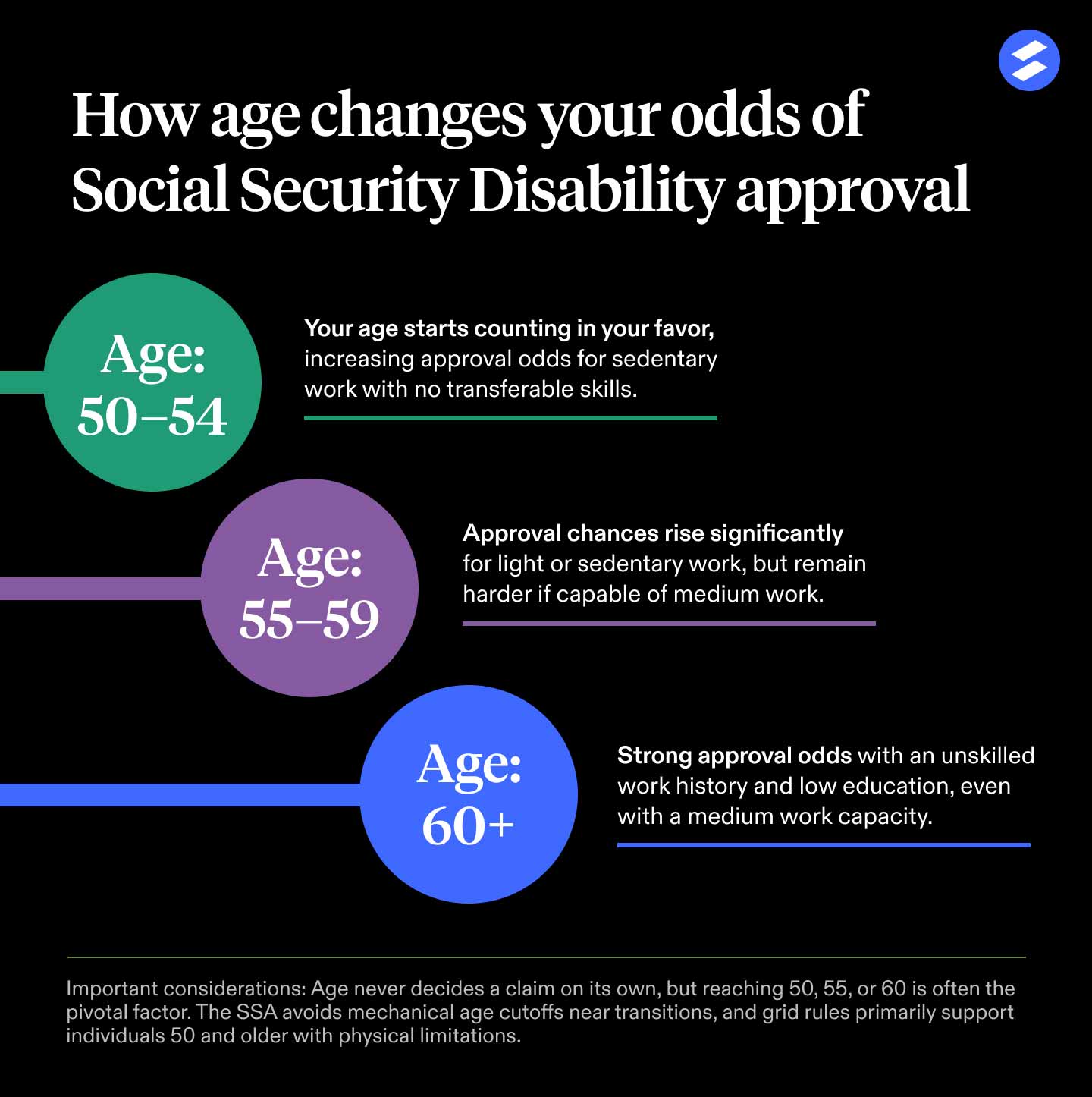
That said, reaching age 50 isn’t a magic switch that guarantees you will get approved. “Age never decides a case on its own, and SSA is not supposed to apply the age lines mechanically when someone is within a few months of the next category, but the birthdays at 50, 55, and 60 can be the single most important fact in a person’s claim,” she says.
Here’s what you need to know about grid rules over 50 / over 55 / over 60, according to the SSA:
50-54
Turning 50 takes you out of the SSA’s “younger category.” For people under 50, the SSA generally assumes age won't seriously affect their ability to adjust to other work. From 50 on, your age can start to count in your favor. On the grid rules, ages 50 to 54 is considered “closely approaching advanced age.” You’ll need to fit more requirements in order to be determined disabled compared to someone over 55 or 60. However, if your age is a factor that significantly limits your ability to adapt to new work and is limited by literacy, you may be declared disabled. Many people have functional restrictions to sedentary work at this age and no transferable skills and get a disabled decision.
55-59
“Advanced age” is considered to be age 55 and over. Many people have functional restrictions to light or sedentary work at this age and no transferable skills and get a disabled decision. If you can still do medium work, however, you’ll have to meet multiple requirements in order to be determined disabled.
60+
Age 60+ is considered to be “closely approaching retirement age.” For folks at this age, SSA also says that you can work if there is very little, if any, work adjustment required to transfer your skills to light work. If you have a work history of unskilled work and have marginal education or less, there are good odds you’ll be found disabled even with a medium RFC at this age.
Two work examples
A 35-year-old with a sedentary RFC
If you are 35 and have a sedentary RFC, you’d consult Table No. 1. According to the grid rules, however, this 35-year-old would likely not be determined disabled. Regardless of education and prior work experience (including no work experience), the grid rules would likely determine that they are not disabled and able to adjust to sedentary work.
A 58-year-old with a light/sedentary RFC and non-transferable skills
At 58, you are considered in the “advanced age” group. If you are in between light or sedentary RFC, Tables 1 or 2 may apply to you. (A disability lawyer or representative can provide more individualized guidance when your RFC is in between groups.) Along with non-transferable skills, if you have limited or less education or have a high school education or more that does not provide for direct entry into skilled work, then you may be determined disabled.
When the grids don't decide your case
The Medical-Vocational Guidelines (grid rules) only come into play if/when you reach step 5. If you don’t get there, you won’t use the grid rules. “They don’t come into play if you win earlier (like at step 3) or lose earlier (such as the SSA finds you can do your past work and you lose at step 4),” says Hershenhorn.
However, there are other instances when the grids are not used. As Hershenhorn has said, your profile should match the rule exactly. However, if your limitations are non-strength related (also called nonexertional; examples include a mental impairment or vision or hearing loss), the grids don’t direct a result, she says. “They are used as a ‘framework,’ and SSA often relies on a vocational expert to say how many jobs are left.” Jobs being left meaning how many realistic options you have for adjusting to other work. This type of information informed by the Dictionary of Occupational Titles, and the O*Net Resource Center.
In addition, if you fall between strength levels (if you could do less than light work, but some work), the grid rules may not be applicable, says Hershenhorn. There are also special situations, of course, which is why having a disability lawyer on your case is valuable.
While the tables themselves are simpler than they look, there’s a lot of information, including regulatory definitions, that describes each term. It’s the SSA that decides what box you fit into — not you yourself, she says. For that reason, you might think you can only do sedentary work, but the SSA could review your file and decide that you can do light work.
Rather than using the grids on your own, Hershenhorn advises hiring a lawyer. “A disability lawyer’s job is to build the medical record so that SSA finds the right remaining physical capacity, make sure their past work is classified correctly, and develop evidence about all of a client’s limitations.” Your lawyer should also write out a grid analysis for the examiner/judge and can cross-examine a vocational expert, if one is invited to testify about your case.
These steps can be hard to manage on your own, especially if you're not familiar with what the SSA expects. Get an expert in your corner who deeply understands the grid rules and all of the factors that go into them. That’s critically important for getting approved or initiating an appeal at one of the four opportunities you have to do so. A disability attorney from Atticus can work with you at every stage along the way.
The bottom line
The SSA grid rules are designed to help direct the SSA in a decision to determine if someone is or is not disabled. It comes in at step 5, the final step in the disability determination process, though not everyone will reach this step. These grid rules are based on four factors: residual functional capacity, age, education, and previous work experience. Although someone can use them to self-assess their own chances of being declared disabled (and thus eligible for disability benefits), it’s not up to you to determine how the grid rules apply to your situation. The SSA has the final word.
Working with a disability lawyer can help your case tremendously. A disability lawyer will help you fill out the application correctly. If you get to the grid rules stage, they can construct your case, write a grid analysis, if needed, and represent you at a hearing appeal if needed. Clients are three times as likely to win benefits with a lawyer's help at the hearing stage.
Frequently asked questions
What is the Social Security GRID rules chart?
The Social Security grid rules chart is step 5 of the 5-step process that the SSA uses to decide if someone has a disability. It is based on four factors: residual functional capacity, age, education, and previous work experience.
What are the grid rules for people 55 and over?
55 and over is considered “advanced age” in the grid rules. The SSA considers that advanced age significantly affects your ability to adjust to other work, and you’re more likely to be deemed disabled compared to younger ages.
Do grid rules help if you're under 50?
It’s more difficult to be determined disabled if you are under 50, as there are more opportunities to find alternate work at a younger age. For someone aged 45 to 49 who is illiterate and has unskilled or no previous work experience, they may be deemed disabled based on the grid rules if their residual functional capacity is for sedentary work.
Is there a grid rule for heavy work?
There is no grid rule for heavy work or very heavy work. In general, if you can do heavy or very heavy work, the SSA usually finds that you can return to the workforce and your claim will likely be denied.
Jessica Migala
Writer
For Clients
For press inquiries, please email press@atticus.com.
Fields of Law
For Lawyers
At the bottom of many websites, you'll find a small disclaimer: "We are not a law firm and are not qualified to give legal advice." If you see this, run the other way. These people can't help you: they're prohibited by law from giving meaningful advice, recommending specific lawyers, or even telling you whether you need a lawyer at all.
There’s no disclaimer here: Atticus is a law firm, and we are qualified to give legal advice. We can answer your most pressing questions, make clear recommendations, and search far and wide to find the right lawyer for you.
Two important things to note: If we give you legal advice, it will be through a lawyer on our staff communicating with you directly. (Don't make important decisions about your case based solely on this or any other website.) And if we take you on as a client, it will be through a document you sign. (No attorney-client relationship arises from using this site or calling us.)
- © 2026 Atticus Law, P.C.
Terms | Privacy | California Privacy | CHD Policy | Disclaimer | This website is lawyer advertising.