Installment | When | 2027 amount |
1st | Within 60 days after approval | up to $3,267 |
2nd | 6 months after the 1st | up to $3,267 |
3rd | 6 months after the 2nd | Remaining balance, $2,727 |
 General
SSI Back Pay: How Much You'll Get, When It Arrives, and How to Protect It
Written by

Jessica Migala
Writer
Reviewed by Maegan Seawright
Direct Representative and Eligible Direct Pay Non-Attorney (EDPNA)
Published November 19, 2026
9 min read
Why trust us?
Atticus is a law firm and Certified B Corp offering free, high-quality advice to Americans who can't work due to disability. Our experienced disability lawyers bring 50+ combined years of experience and help 100,000+ apply for benefits each year.
Key takeaways
Supplemental Security Income (SSI) back pay covers the months between your SSI application and approval.
The 2027 federal SSI payment rate is $1,029 per month.
The first installment of SSI back pay will arrive within about 60 days of approval. If applicable, the second installment will be paid to you six months later, and the third installment will be paid six months after that. (If applicable.)
You have 9 months after each SSI back payment to spend down this money. Pay off debts, use it for basic living needs, healthcare coverage, medical care, or pay educational expenses.
SSI back pay should not affect your benefits as long as you stay below the SSI resource limit after the 9 month grace period.
It’s a great day. You just received your award letter. You’re approved to receive Supplemental Security Income (SSI) from the Social Security Administration (SSA). But you realize something. You’ve been waiting a long time for this approval. In the months since you applied, you’ve gone without SSI payments. So, what happens now? Do you get SSI back pay?
This article will walk through what SSI back pay is, when it starts, how to estimate your payment, common deductions from back pay, and how to protect your eligibility. Plus, learn how a disability attorney can help you navigate this process and maximize your benefit.
What is SSI back pay?
SSI back pay covers the months between when you applied for SSI and your approval. It is SSA’s way of making up for what they would owe you if you were approved as soon as you submitted your application.
There’s a long delay between application and approval because multiple people across different agencies review your claim, says Paul Leroux, lead attorney at Atticus. Within the process of SSI, Social Security must check your income and assets, and then it moves on to state and medical review. This can take many months, but, says Leroux, you’ll accrue back pay during and have time to create a strong claim to prove your disability.
Here are several things you need to know about SSI back pay rules:
The clock on back pay starts the month after you apply and ends at the time of your approval.
You will receive back pay in installment payments if past-due SSI payments and the payment amount equals or exceeds three times the current maximum Federal Benefit Rate (FBR) amount. In this article, we call this the SSI rate.
The SSA will pay installment payments in no more than three payments.
Each payment is spaced six months apart.
The first and second installment payments cannot exceed three times the SSI rate (plus any State supplement).
The third (final) payment is the remaining balance of SSI back pay.
This process differs from Social Security Disability Insurance (SSDI). If your application for SSDI is approved, you have to wait five calendar months from when the SSA found your disability began before you can recieve benefit payments.
“The biggest surprise people have regarding SSI back pay is that for SSI, there’s no back pay from before you applied. So even if you became disabled long before you applied, if you’re getting SSI [and not SSDI], your back pay goes back only to the month after you applied,” Leroux explains.
How much is back pay for SSI?
When figuring out back pay, use this two-part formula that determines how SSI is calculated:
Monthly federal SSI rate + state supplement - countable income = Total SSI per month
Total SSI per month x months owed = Total back pay
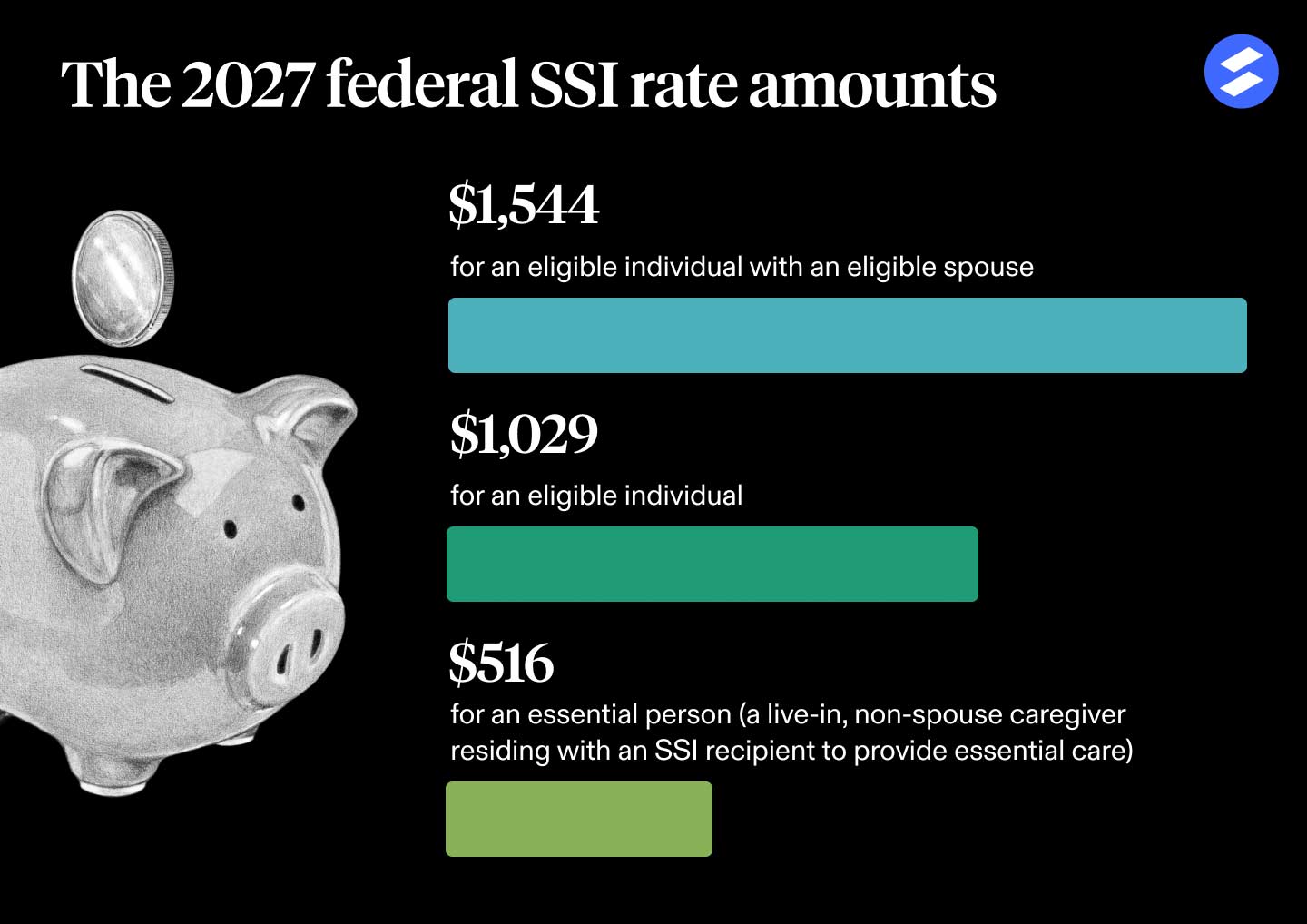
The 2027 federal SSI rates are:
$1,029 for an eligible individual
$1,544 for an eligible individual with an eligible spouse
$516 for an essential person.
An essential person is someone who has continuously lived in the home of the qualified individual since December 1973.
State supplement: Most states supplement SSI with another payment. States that do not pay a supplement are Arizona, Arkansas, Mississippi, North Dakota, Northern Mariana Islands, Tennessee, and West Virginia. Some states administer their own supplemental payment, while the SSA administers it for others. Check the SSA page to know the rules of your state, the benefit amount, and how to apply.
Countable income: Your monthly amount will be reduced by subtracting any countable income. Countable income is defined as anything you receive during a calendar month that counts as food or shelter. Income can be cash or what’s called “in-kind.” In-kind income can be food or shelter or something you receive that can be used toward food and shelter. There are exclusions worth knowing that are not considered countable income. Those include rent subsidies under the Department of Housing and Urban Development (HUD) programs and Supplemental Nutrition Assistance Program .
Worked example
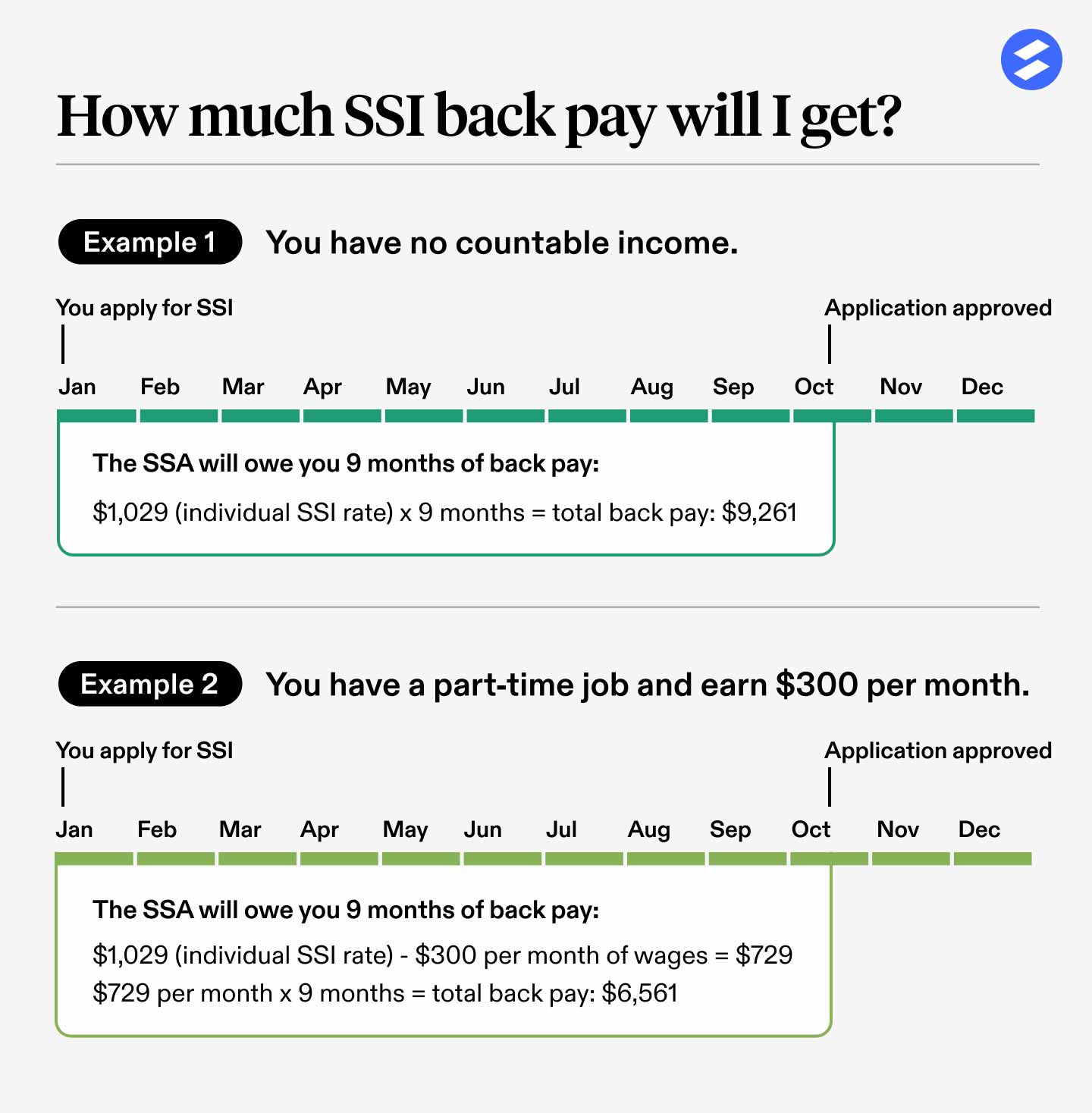
You have an established onset date (the date the SSA says your disability started) of January 2027 and apply for SSI that same month. You are approved in October 2027. The SSA would owe you 9 months of back pay.
$1,029 (individual SSI rate for 2027) x 9 months = $9,261.
You have no countable income, so the total SSI owed to you is $9,261.
However, let’s take the above example and tweak it. Now, you have a part-time job and earn $300 per week. This is considered earned income. Here’s how the math plays out:
$300 (Gross wages) - $20 (first $20 is excluded) - $65 (also not counted) = $215
Then, take $215 and divide by ½ = $107.50
$107.50 is your countable income
The equation is SSI individual rate - countable income = monthly SSI federal benefit
$1,029 (individual SSI rate) - $107.50 = $921.50 is your monthly SSI federal benefit
$921.50 x 9 months = $8,293.50
One more calculation for unearned income, such as your Social Security benefit. To compare, we’ll say that this is $300:
$300 - $20 (first $20 is excluded) = $280 countable income
$1,029 - $280 = $749 is your monthly SSI federal benefit
$714 x 9 months = $6,741
How SSI back pay is paid: the installment rule
Calculating SSI back pay installments can seem confusing. It’s important to know what to expect. That way, you can properly plan for household spending.
Timing: You’ll get the first installment within about 60 days of approval. SSI back pay second installment will come six months later, and the third installment will be paid six months after that.
Payment: Installments one and two are capped at three times the SSI monthly rate. Installment three is the remaining balance.
For awards below the threshold, you’ll get one payment within one or two months of approval.
The below is based on an example of 9 months of total back pay, using the 2027 SSI amount.
Can I get my SSI back pay faster?
There are certain circumstances that allow you to get SSI back pay faster. The SSA will pay the entire back pay balance in full if:
You are terminally ill: If you have a medical condition that is expected to result in death within 12 months.
You are no longer eligible for SSI, and you probably won't be eligible for the next 12 months.
In addition, the SSA can start SSI payments faster. This is called expedited benefits. They apply if you have:
Presumptive disability or presumptive blindness payment
Emergency advance payment
Immediate payment
Expedited reinstatement cases
Each of the above has different rules about who is eligible and who is not, how much of a payment you can receive, and when. Talking to a knowledgeable disability representative at Atticus can guide you through this process and help you get your SSI payments as quickly as possible. As an example of how this has worked in the past, Atticus had been able to get Social Security to release funds quickly for a client at risk of eviction. That’s not a guaranteed outcome, but, says Leroux, it's one reason why having an advocate by your side can help.
When will I receive my SSI back pay, and how do I check it?
After receiving your eligibility letter, you will typically receive the first payment within 60 days. This money can get to you in one of two ways: via direct deposit into a bank account you already have or onto a Direct Express Debit Mastercard.
You have to choose one of these two electronic payment options when you enroll in SSI.
As for how to track SSI back pay online and by phone, you have a few options:
Sign in to your SSA account
Call the SSA phone line at 800-772-1213
Visit your local SSA office
If you believe your SSI payment is late, you should call your financial institution first to check on the status. If that doesn’t resolve the issue, check the status online via your SSA account or call the SSA phone line.
What can be taken out of SSI back pay?
SSI back pay isn’t a straightforward amount. Attorney fees, Interim Assistance Reimbursement, Social Security benefits, and countable income can all reduce your back pay. Here’s a look at each:
Attorney fees: This fee cannot exceed 25% of your back pay, up to $9,200. However, it cannot be taken from your monthly checks.
Interim Assistance Reimbursement: You may receive interim assistance from the state while you wait for your SSI application to be approved. This assistance is to go toward meeting your basic needs.
The SSA will ask your state how much interim assistance the state paid to you. The SSA will then pay the State back from your SSI payment until the state is reimbursed.
Social Security benefits: This is a rule called the “Windfall Offset.” If you are eligible for SSI back pay and Social Security benefits for the same month, you do not get the full amount for both of those programs. Instead, SSI is subtracted from your Social Security benefits. Essentially, SSDI counts as unearned income.
Countable income: As discussed above, countable income is income that you receive that you can use to meet your needs for food or shelter.
SSI back pay for children
When it comes to SSI for children, you’ll also want to consider any past-due payments they’re owed. If you have a child with a disability who is under age 18, you are required to open a dedicated account for large SSI back payments.
A large past-due payment is one that exceeds six times the monthly SSI rate. In 2027, that is $6,174. (This applies if you are the representative payee, which is the person the SSA selects to manage these benefits.)
There are a few SSI back pay rules for a child. You can only use the money for the following:
Medical expenses
Education
Job skills training
Expenses related to a child’s impairment, such as in-home nursing care, special equipment, or therapy
If you are the representative payee, the SSA advises keeping receipts and other records of how this money was used for at least two years. You’ll also need to complete a report every year to show how the money was used.
How to keep SSI back pay from costing you your benefits
It is really important to learn about the SSI resource limit and how it applies to you.
There is a limit for “countable resources.” For an individual, it’s $2,000. For a couple, it is $3,000. Resources are cash or property beyond the home you live in and generally one car.
Resources you have are a key factor that affects whether you’re eligible for SSI. If you go over the resource limit, then you won’t get SSI for that month.
The good news is that unspent back pay does not count toward the $2,000/$3,000 resource limit for 9 months after the month you receive it. For example, once you receive the first installment, you have 9 months to spend the payment. After the second installment, you have 9 months to spend that.
After 9 months, any remaining money can be considered a resource. This could count against your eligibility for SSI.
You have options for spending down SSI back pay so it doesn’t count against you. Pay off debts, use it for basic living needs, healthcare coverage, medical care, or pay educational expenses. What’s important is using the SSI back pay for things that do not count as resources. It’s also something important to keep in mind because it can help you plan appropriately when making the decision to save or spend back pay, says Leroux.
Remember to keep receipts so you can maintain a good record of spending and report any changes in your circumstances to the SSA.
SSI back pay vs. SSDI back pay
SSI and SSDI are two separate disability benefits programs. SSDI pays monthly benefits to people who have a disability that affects their ability to work. SSI, which we’ve focused on throughout this article, provides monthly payments to people with disabilities and older adults who have little or no income or resources.
SSI and SSDI differ in terms of when back pay begins, waiting period for payment, how you’re paid, and other rules. Here’s a helpful breakdown of the differences in the rules between SSI and SSDI back pay.
SSI back pay | SSDI back pay | |
Starts | Month after you apply | Month 6 after disability onset |
Months before application | None | Up to 12 |
Waiting period | None | 5 months |
How paid | Up to 3 installments if at or above 3× the monthly SSI rate | Usually one lump sum |
Counts as a resource? | Excluded for 9 months | Excluded for 9 months if you're on SSI |
Frequently asked questions: SSI Back Pay
Do you get back pay from SSI?
Yes, if you apply and are approved, you can get back pay from SSI. First, the SSA needs to approve your disability claim. Then, you’ll receive an established onset date, which is the date the SSA says your disability started. SSI back payments will start from the month after you apply until you are approved.
Is SSI back pay paid all at once?
SSI back pay will be paid in three installments if the amount equals or exceeds three times the most recent monthly SSI rate. These installments are spaced six months apart.
Can you get both SSI and SSDI back pay?
Yes, but there are limitations. SSDI counts as income. For the months that you could get both SSI and SSDI, your payment will be reduced. The SSA calculates this by subtracting SSI from your other Social Security benefits.
Is SSI back pay taxable?
No, Supplemental Security income (SSI) back pay is not taxable. Social Security benefits, including retirement, survivor, and disability benefits, are taxable.
Can child support or creditors take SSI back pay?
SSI is generally protected from garnishment because it’s based on a need for basic necessities. Other Social Security benefits can be withheld for child support, alimony, or restitution. A disability attorney can talk to you about your specific situation.
Do you need a lawyer to get SSI back pay?
Hiring a lawyer is not required to get SSI back pay. However, representation by a knowledgeable attorney can increase your chances of winning. People are three times more likely to win benefits with a lawyer at a hearing compared to going through the process on their own.
Not only will an attorney help calculate expected back pay, they’re invaluable in keeping the process moving, says Leroux. “The biggest way eligible people lose their claims is by giving up after a denial, and for most people, this reduces the back pay they’ll ultimately receive.” An attorney or other disability representative will push through an appeal so that you don’t have to start the process over again.
Remember that any attorney fee only comes from back pay awarded. This fee is capped at 25% or $9,200 of what you’re awarded. You don’t have to pay anything up front. If you’re interested in exploring your options, take this short quiz to learn about what benefits may be available to you.
Jessica Migala
Writer
Jessica Migala is a health journalist with nearly 20 years of experience covering health and medical topics for national publications, including AARP, Real Simple, Women's Health, Everyday Health, and WebMD. She earned a degree in magazine journalism from Syracuse University's Newhouse School of Public Communications and previously held editorial roles at Prevention and Michigan Avenue magazines. She has also held interim and freelance editorial positions at Women's Health, EatingWell, Diabetic Living, and Simply Recipes. Her work spans dozens of print and digital publications, websites, and health-focused brands.
For Clients
For press inquiries, please email press@atticus.com.
Fields of Law
For Lawyers
At the bottom of many websites, you'll find a small disclaimer: "We are not a law firm and are not qualified to give legal advice." If you see this, run the other way. These people can't help you: they're prohibited by law from giving meaningful advice, recommending specific lawyers, or even telling you whether you need a lawyer at all.
There’s no disclaimer here: Atticus is a law firm, and we are qualified to give legal advice. We can answer your most pressing questions, make clear recommendations, and search far and wide to find the right lawyer for you.
Two important things to note: If we give you legal advice, it will be through a lawyer on our staff communicating with you directly. (Don't make important decisions about your case based solely on this or any other website.) And if we take you on as a client, it will be through a document you sign. (No attorney-client relationship arises from using this site or calling us.)
- © 2026 Atticus Law, P.C.
Terms | Privacy | California Privacy | CHD Policy | Disclaimer | This website is lawyer advertising.